01 / REAL ROBOT
Teleoperation
Precise demonstrations grounded in real sensor and actuator statistics.
COLLECTION COSTHIGH
Technical Report · 2026 · NVIDIA × HKUST (GZ)
Force-aware manipulation requires a robot to infer appropriate interaction forces from task context and tactile feedback. Tacinf is a low-cost modular infrastructure that predicts actions and fingertip forces from language, vision, and touch, with an optional language-conditioned force level for explicit force regulation. It combines simulation data synthesis and a tactile benchmark (Tabero), policy learning (VTLA), handheld data collection with a shared deployment gripper (Tacumi), and task-aligned simulation-to-real evaluation (Taco). Across eight policy variants, simulation preserves real-robot success ordering (Pearson r=0.998, MMRV=0.010). Mixed teleoperation, simulation, and Tacumi training raises success from 20% to 60% on position-randomized out-of-distribution objects.
Data synergy · three-source co-training
Three complementary streams balance collection cost and capability: simulation scales visual and object diversity, Tacumi expands where and how objects are grasped, and teleoperation anchors demonstrations in real sensor and actuator statistics.
Precise demonstrations grounded in real sensor and actuator statistics.
Replay trajectories and scale object appearance and background variation.
Parallel demonstrations expand object positions and grasp approaches.
Aligned observations · actions · tactile and force labels
The system
Together, the modules support tactile data synthesis and collection, force-aware policy learning, and task-aligned sim-to-real evaluation.
Minimum compute for all modules: one RTX 4090 workstation.
Tacinf–Tacumi · Hardware and collection
Tactile demonstrations, with active load feedback.
Guide the gripper by hand. Feel changes in grasp load. Record the motion, vision, and touch that a robot needs to learn contact-rich manipulation.
A handheld interface for teaching without a robot arm. The operator controls the grasp through an active trigger while the device records end-effector motion, gripper opening, and contact observations.
The motorized trigger commands the grasp and returns resistance derived from gripper-motor load.
Quest 3 tracks a controller fixed to the device; a calibrated transform maps its pose to the gripper tool center.
The gripper motor design and command/state interface carry from handheld collection to robot execution.
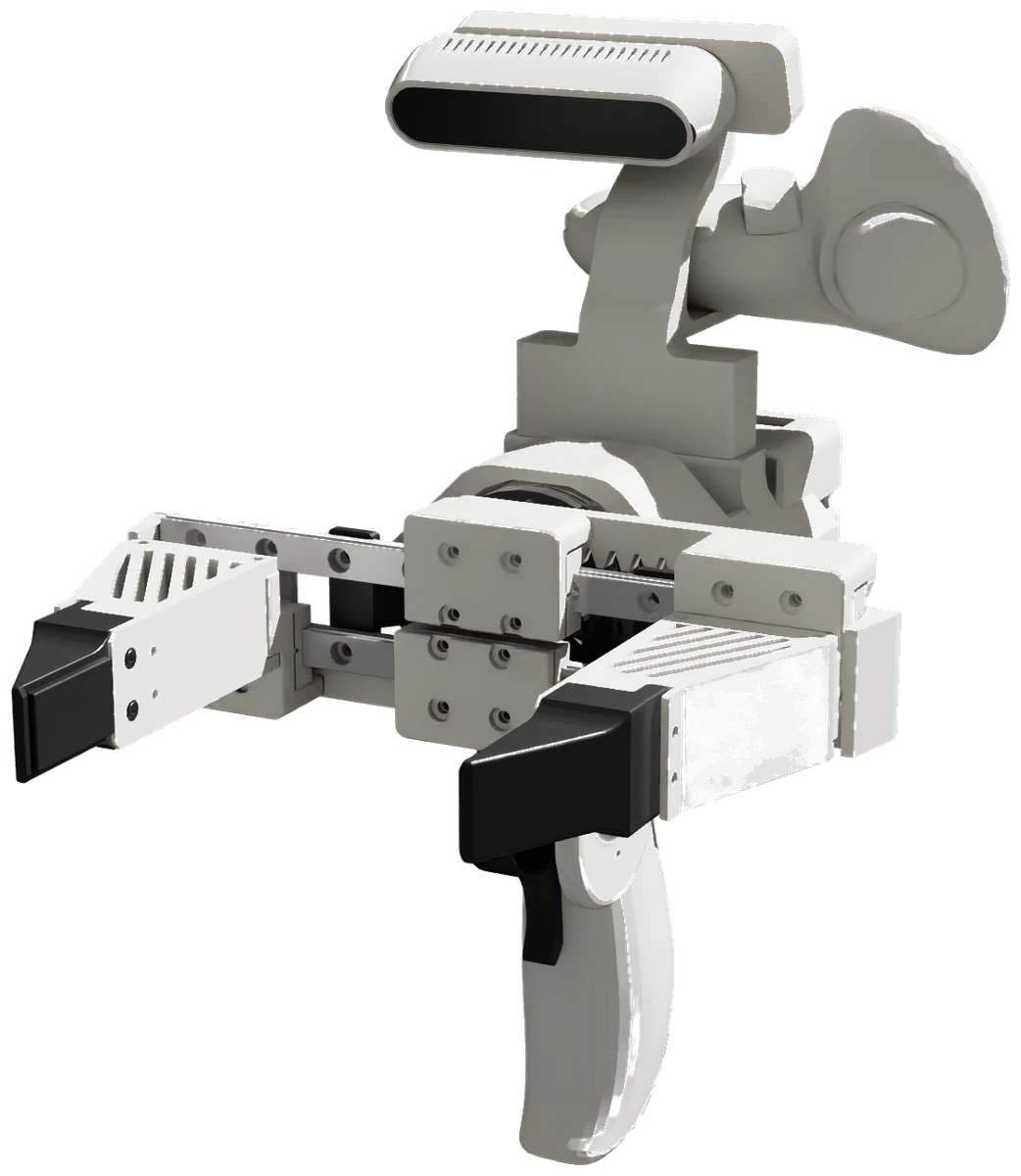
01 / Hardware
Grasp input, load feedback, tracking, and contact sensing in one hand-operated device.
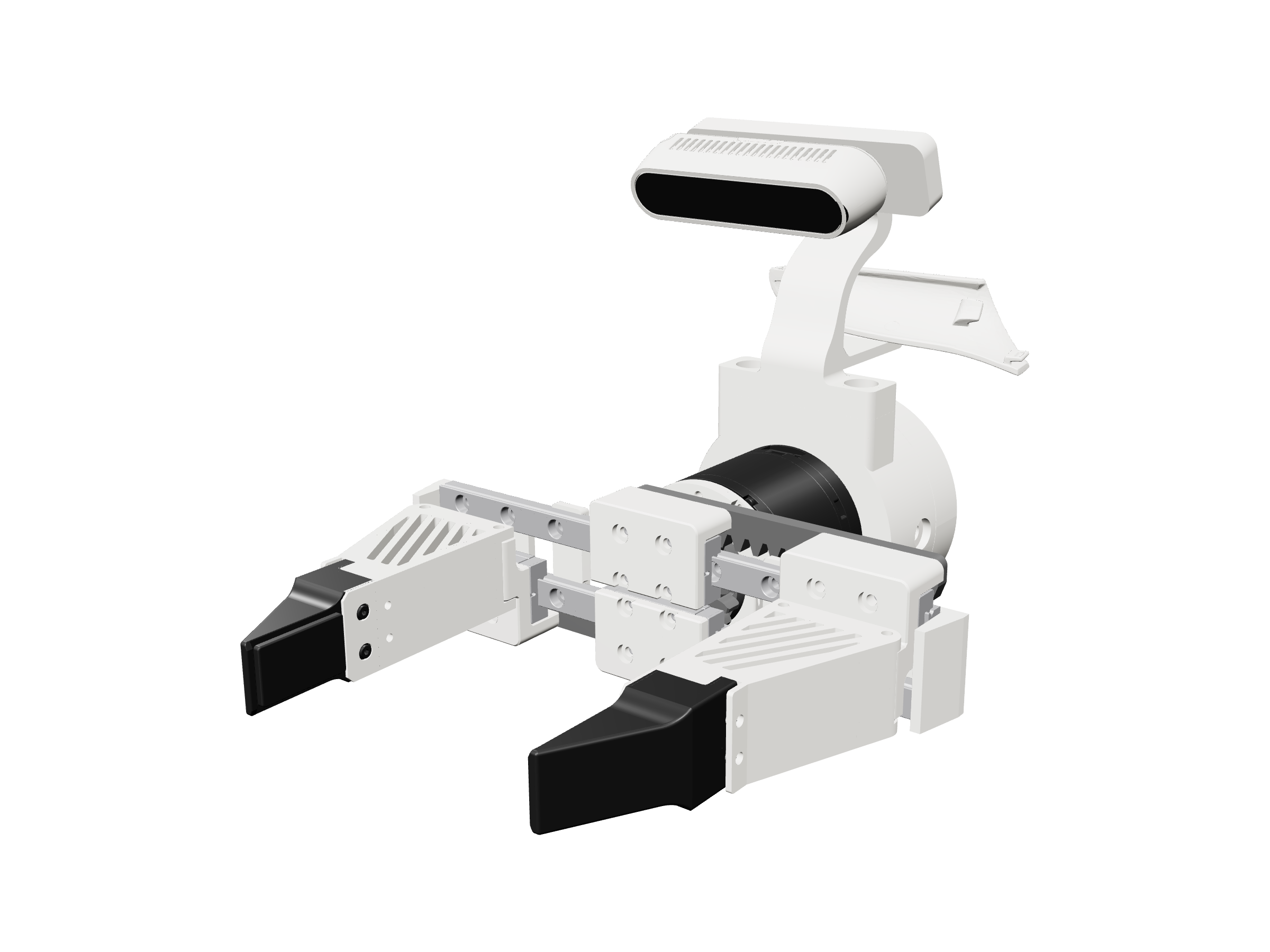
02 / Robot-side execution
A separate robot-side assembly carries the gripper drive, camera, and tactile fingertips onto the arm.
03 / Collection
Robot teleoperation and handheld UMI examples, each showing third-person, wrist-camera, and tactile views.
The same handheld setup records these observations across UMI and UMI+ tasks, from pick-and-place to connector insertion and towel folding. Each clip shows a single task from the third-person camera.
04 / Data pipeline
A common data schema connects handheld collection with teleoperation, simulation, and policy training.
Move the device through the task and command the opening with the trigger. Gripper-motor load is returned as active resistance.
Map tracked controller poses to the gripper tool center and record visual, tactile, and motor streams against a shared host-time reference.
Combine demonstrations through the common schema, then execute with the reused gripper drive and command/state interface.
A fixed controller-to-tool transform converts controller poses into gripper tool-center poses in the Quest tracking frame. Calibrate this relationship again when the mounting geometry changes.
Pose, images, tactile observations, and motor states carry timestamps from the collection host. These streams have different native sampling rates; a shared clock does not imply simultaneous physical acquisition.
05 / Resources
Collection code, demonstrations, sensor calibration, and the shared training pipeline.
Tacumi uses XenseSDK 2.1.1 for tactile sensing. Calibration files support tactile simulation.
SDK docs ↗Calibration ↗Tabero · ICML 2026 / Benchmark + force-aware VTLA
Learning gentle manipulation with closed-loop force feedback from vision, touch, and language.
Tabero turns open-source manipulation trajectories into vision–tactile–language tasks in Isaac Lab with Taxim/FOTS. Its force-aware VTLA pairs a decoupled force–position interface with a fixed hybrid controller, cutting average grip force by over 70% under gentle instructions while preserving task success.
Benchmark assets, sensor data, and calibration for tactile simulation.
Dataset ↗Calibs ↗USD scenes and augmented variants for replaying the benchmark tasks.
USD ↗USD_aug ↗Reference tactile policy checkpoints used in the Tabero benchmark.
π₀ field ↗π₀.₅ field ↗Language sets the force. The same milk task under firm and gentle commands. Demos from the Tabero repository.
Open-source trajectories become tactile tasks.
Isaac Lab with Taxim/FOTS tactile simulation.
Language, vision, touch, and 6-D force at 20 Hz.
Task success plus four gentleness metrics.
Tacinf–VTLA · Policy
Vision–language–action, with force as a first-class output.
A modular tactile interface for foundation VLA models. Marker-field, tactile-image, and 6-D force adapters feed a shared backbone; the policy predicts pose and fingertip-force setpoints, and a hybrid controller tracks both. Force is decoupled from position, so language can set how hard to hold without rewriting the motion.
Field, force, image, and no-tactile LoRA variants for comparison.
π₀ force ↗π₀.₅ image ↗Replay datasets shared by simulation and real-robot policy evaluation.
Replay data ↗Current ↗Sensor calibration and assets used by the tactile adapters.
Xense calibs ↗Vision-only reference checkpoint for ablation comparisons.
π₀.₅ no tac ↗Real-robot execution / VTLA
Blackboard wiping, card swiping, and switch turning with the tactile policy and controller running on the xArm 7. xArm Python SDK ↗
Tacinf–Taco · Sim-to-real
A simulator that earns its seat next to the real robot.
Taco aligns the workspace, objects, robot, cameras, and tactile response for paired simulation and real-robot evaluation. It also supports mixed-data policy post-training across teleoperation, simulation, and Tacumi demonstrations.
Real, replayed, and UMI demonstrations for matched sim-to-real evaluation.
Real ↗Replayed ↗UMI ↗Augmented replay and firm-force variants for mixed-data post-training.
Replay+ ↗UMI+ ↗Firm ↗Checkpoints for real, sim, UMI, and three-source mixtures.
Real + sim ↗Real + sim + UMI ↗Evaluation in the paper ↗ Tabero benchmark Coming soon Explore the data flow ↑
SIM ↔ REAL · CONTEXTUAL COMPARISON
Evidence / paired evaluation
The paper reports this success-only comparison; measured force retains a small sim-to-real gap.
Replay data also align across visual, tactile, and action channels: CLIP similarity > 0.75, tactile SSIM > 0.93, and action MAE < 0.074.
Citation
Cite the technical report. The Tabero benchmark has its own repository, paper, dataset, and weights.
If Tacinf is useful to your work, please cite the technical report.
@misc{wu2026tacinf,
  title         = {{Tacinf}: A Unified Tactile Infrastructure
                   for Robot Manipulation},
  author        = {Wu, Qiwei and Chen, Xiangyu and Xiang, Xin
                   and Zhang, Rui and Kang, Yihang and Chen, Weiran
                   and Xie, Zikang and Li, Yangfan and Wang, Tao
                   and Wang, Xiangzheng and Bi, Tianyi and Zhang, Zhiyan
                   and Wang, Xianpeng and Zhou, Mingqian and Yu, Yan
                   and Li, Chuanyu and Zhang, Wenjie and Li, Tao
                   and Zhang, Weihua and Xu, Renjing and Lai, Junjie},
  year          = {2026},
  eprint        = {2611.29240},
  archivePrefix = {arXiv},
  primaryClass  = {cs.RO},
  url           = {https://arxiv.org/abs/2611.29240}
}