01 / REAL ROBOT
VR teleoperation
Precise demonstrations grounded in real sensor and actuator statistics.
COLLECTION COSTHIGH
Technical Report · 2026 · NVIDIA × HKUST (GZ)
Force-aware manipulation requires a robot to infer appropriate interaction forces from task context and tactile feedback. Tacinf is a low-cost modular infrastructure that predicts actions and fingertip forces from language, vision, and touch, with an optional language-conditioned force level for explicit force regulation. It combines simulation data synthesis and a tactile benchmark (Tabero), policy learning (VTLA), handheld data collection with a shared deployment gripper (Tacumi), and task-aligned simulation-to-real evaluation (Taco). On Taco’s six Pick and Place tasks, the eight policy variants in the paper yield Pearson r=0.998 and MMRV=0.010 between simulated and real-robot mean success rates. With both object positions and instances randomized, mean real-robot success rises from 20% with VR teleoperation alone to 60% with VR, simulation, and Tacumi UMI data.
Data synergy · three-source co-training
For Pick and Place, simulation replay and ReplayPlus expand object and appearance coverage, Tacumi UMI adds variation in grasp approaches and object positions, and VR teleoperation records demonstrations on the real robot.
Precise demonstrations grounded in real sensor and actuator statistics.
Replay trajectories and scale object appearance and background variation.
Parallel demonstrations expand object positions and grasp approaches.
Aligned observations · actions · tactile and force labels
The system
Together, the modules support tactile data synthesis and collection, force-aware policy learning, and task-aligned sim-to-real evaluation.
Minimum compute for all modules: one RTX 4090 workstation.
Tacinf–Tacumi · Hardware and collection
Tactile demonstrations, with active load feedback.
Guide the gripper by hand. Feel changes in grasp load. Record the motion, vision, and touch that a robot needs to learn contact-rich manipulation.
A handheld interface for teaching without a robot arm. The operator controls the grasp through an active trigger while the device records end-effector motion, gripper opening, and contact observations.
The motorized trigger commands the grasp and returns resistance derived from gripper-motor load.
Quest 3 tracks a controller fixed to the device; a calibrated transform maps its pose to the gripper tool center.
The gripper motor design and command/state interface carry from handheld collection to robot execution.
01 / Hardware
Grasp input, load feedback, tracking, and contact sensing in one hand-operated device.
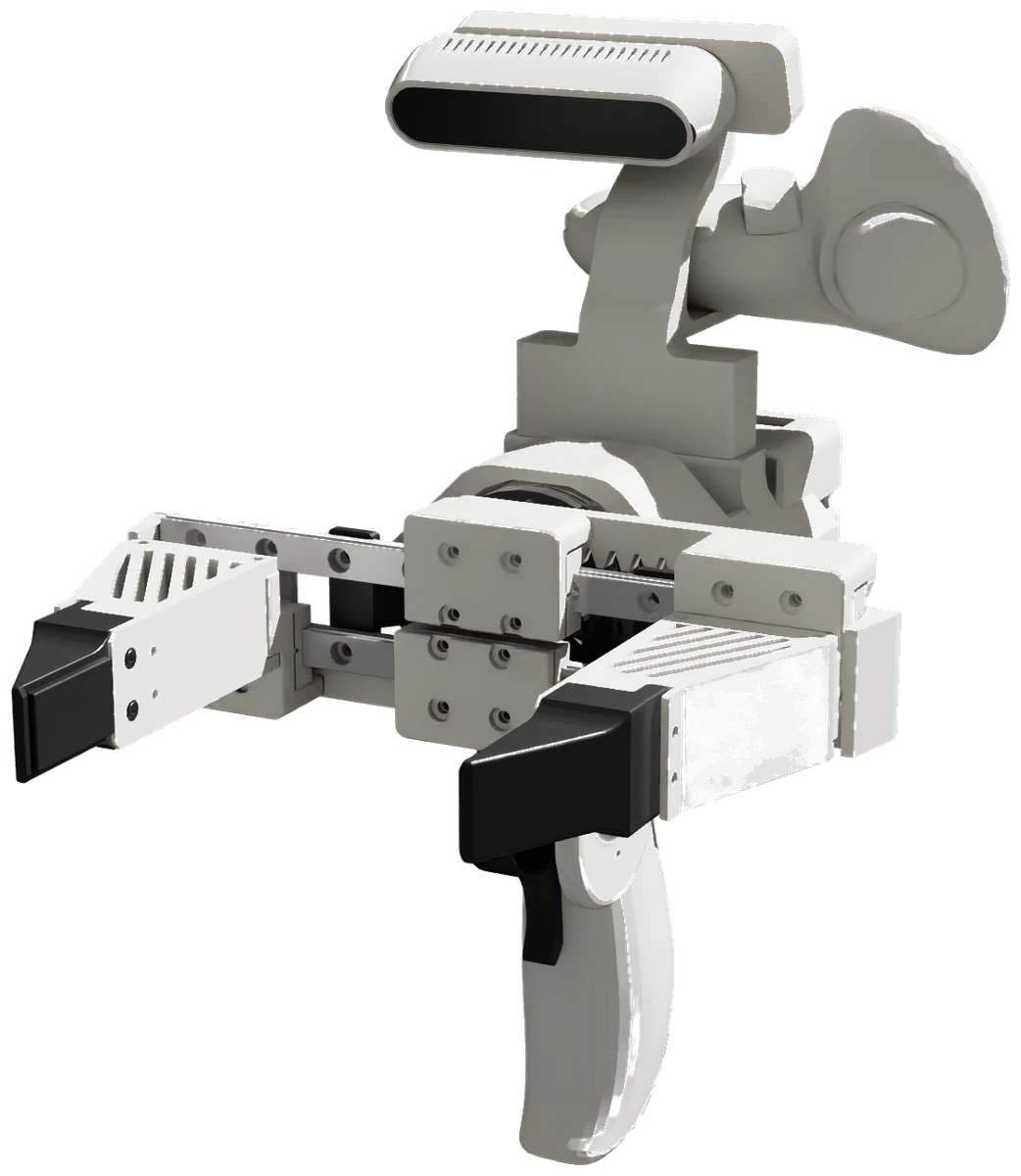
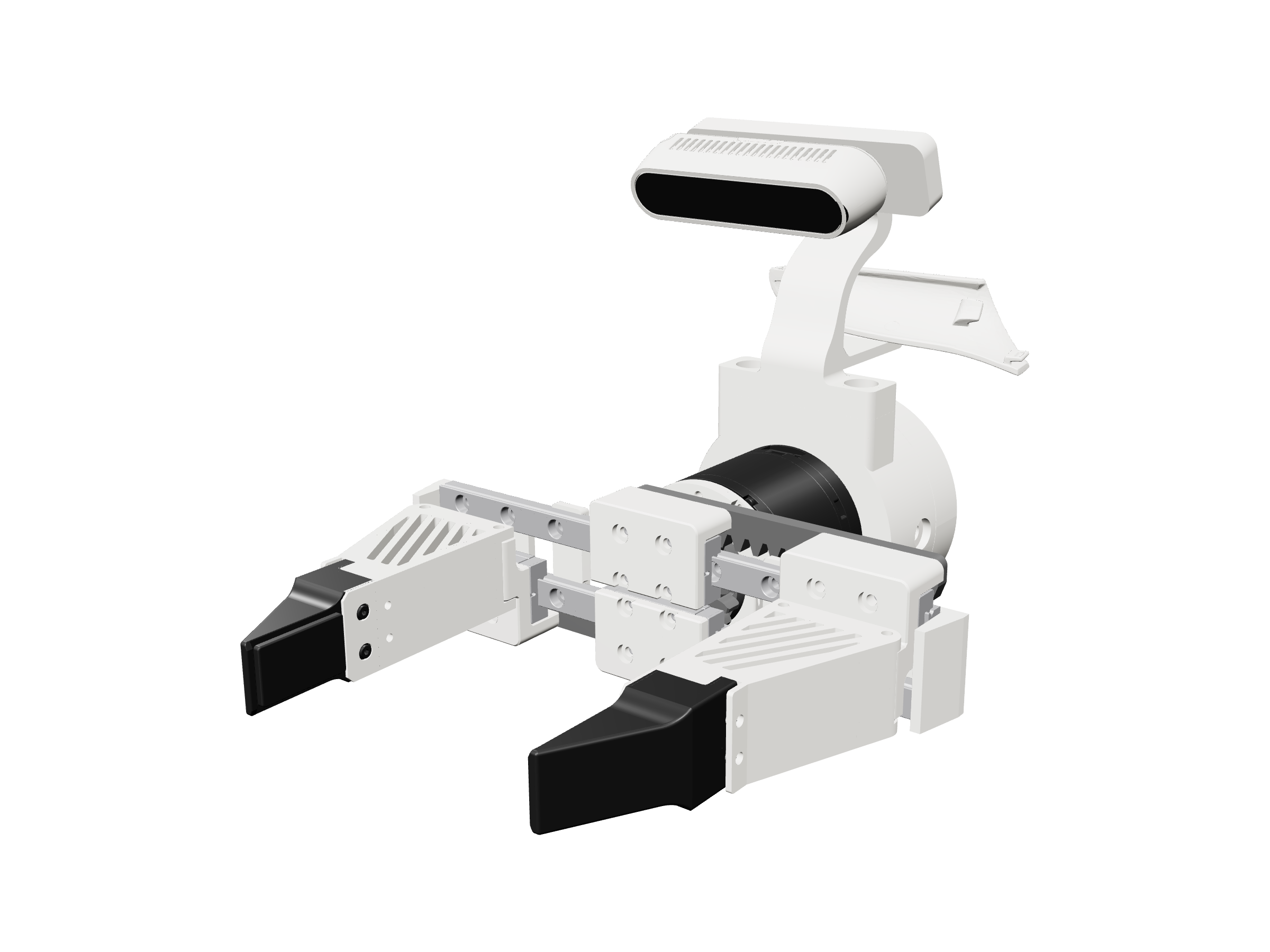
02 / Robot-side execution
A separate robot-side assembly carries the gripper drive, camera, and tactile fingertips onto the arm.
03 / Collection
Robot teleoperation and handheld UMI examples, each showing third-person, wrist-camera, and tactile views.
Third-person clips show tasks from Pick and Place UMI and Supplemental UMI. Pick and Place has Firm and Gentle instructions for each of the three objects.
04 / Data pipeline
A common data schema connects handheld collection with teleoperation, simulation, and policy training.
Move the device through the task and command the opening with the trigger. Gripper-motor load is returned as active resistance.
Map tracked controller poses to the gripper tool center and record visual, tactile, and motor streams against a shared host-time reference.
Combine demonstrations through the common schema, then execute with the reused gripper drive and command/state interface.
A fixed controller-to-tool transform converts controller poses into gripper tool-center poses in the Quest tracking frame. Calibrate this relationship again when the mounting geometry changes.
Pose, images, tactile observations, and motor states carry timestamps from the collection host. These streams have different native sampling rates; a shared clock does not imply simultaneous physical acquisition.
05 / Resources
Collection code, demonstrations, and the tactile SDK.
Handheld demonstrations for Pick and Place and eight supplemental tasks.
Pick and Place UMI ↗Supplemental UMI ↗Handheld tactile collection code and the shared gripper interface.
Coming soonTabero · ICML 2026 / Benchmark + force-aware VTLA
Learning gentle manipulation with closed-loop force feedback from vision, touch, and language.
Tabero turns open-source manipulation trajectories into vision–tactile–language tasks in Isaac Lab with Taxim/FOTS. Its force-aware VTLA pairs a decoupled force–position interface with a fixed hybrid controller, cutting average grip force by over 70% under gentle instructions while preserving task success.
Isaac Lab benchmark environments and tools for data conversion and evaluation.
Benchmark code ↗VTLA code ↗Calibration data used by Tabero's tactile simulator.
Calibration dataset ↗Pretrained π₀ marker-field policy for the Tabero benchmark.
π₀ checkpoint ↗Language sets the force. The same milk task under firm and gentle commands. Demos from the Tabero repository.
Open-source trajectories become tactile tasks.
Isaac Lab with Taxim/FOTS tactile simulation.
Language, vision, touch, and 6-D force at 20 Hz.
Task success plus four gentleness metrics.
Policy
Vision–language–action, with force as a first-class output.
A modular tactile interface for foundation VLA models. Marker-field, tactile-image, and 6-D force adapters feed a shared backbone; the policy predicts pose and fingertip-force setpoints, and a hybrid controller tracks both. Force is decoupled from position, so language can set how hard to hold without rewriting the motion.
Real-robot execution / VTLA
The tactile policy and controller run on the xArm 7 for whiteboard wiping, fan-knob turning, and card swiping. xArm Python SDK ↗
Tasks are counted by language instruction.
| VR teleoperation | 6 tasks |
|---|---|
| Sim Replay (4×4) | 6 tasks |
| Sim Replay (Current) | 6 tasks |
| ReplayPlus (augmented sim replay) | 30 tasks |
| Handheld UMI | 6 tasks |
4×4 arranges the eight most recent tactile frames from each fingertip in a 4×4 grid. Current places one frame from each fingertip side by side at the same timestep.
| VR teleoperation | 3 tasks |
|---|
| Handheld UMI | 8 tasks |
|---|---|
| VR teleoperation | 5 tasks |
Pinned at step 29999 on Hugging Face.
| Policy | Evaluation conditions |
|---|---|
| π₀.₅ marker field (no state) | Controller on and off |
| π₀.₅ tactile image (no state) | Controller on |
Both Real++ checkpoints cover whiteboard wiping, fan-knob turning, and card swiping.
| Training mix | Dataset composition |
|---|---|
| VR only | VR |
| UMI only | UMI |
| VR + UMI | VR + UMI |
| VR + Sim | VR + Sim Replay + ReplayPlus |
| Sim + UMI | Sim Replay + ReplayPlus + UMI |
| VR + Sim + UMI | VR + Sim Replay + ReplayPlus + UMI |
The co-training evaluation randomizes object positions in one setting and both positions and object instances in the other.
Tacinf–Taco · Sim-to-real
A simulator that earns its seat next to the real robot.
Taco aligns the workspace, objects, robot, cameras, and tactile response for Pick and Place evaluations in simulation and on the real robot. It also supports Pick and Place co-training and Real++ controller evaluation.
Across the three Firm Pick and Place tasks.
Two Pick and Place tests vary where objects start and which objects the robot encounters. Both use the same basket as the placement goal.
Training mixes with results for both Firm and Gentle instructions. Each value averages the two success rates.
| Training mix | Position only | Position + object |
|---|---|---|
| VR only | 31.7% | 20.0% |
| VR + UMI | 76.7% | 10.0% |
| VR + Sim | 40.0% | 30.0% |
| Sim + UMI | 66.7% | 40.0% |
| VR + Sim + UMI | 70.0% | 60.0% |
VR + UMI performs best when only positions change. The three-source mix leads when the robot also encounters new objects.
@misc{wu2026tacinf,
  title         = {{Tacinf}: A Unified Tactile Infrastructure
                   for Robot Manipulation},
  author        = {Wu, Qiwei and Chen, Xiangyu and Xiang, Xin
                   and Zhang, Rui and Kang, Yihang and Chen, Weiran
                   and Xie, Zikang and Li, Yangfan and Wang, Tao
                   and Wang, Xiangzheng and Bi, Tianyi and Zhang, Zhiyan
                   and Wang, Xianpeng and Zhou, Mingqian and Yu, Yan
                   and Li, Chuanyu and Zhang, Wenjie and Li, Tao
                   and Zhang, Weihua and Xu, Renjing and Lai, Junjie},
  year          = {2026},
  eprint        = {2611.29240},
  archivePrefix = {arXiv},
  primaryClass  = {cs.RO},
  url           = {https://arxiv.org/abs/2611.29240}
}